
Shape

Making Tax Digital Accountants


- An Overview

Making Tax Digital (MTD)

Since the government introduced its Making Tax Digital (MTD) initiative in 2015, HMRC has been transforming how millions of businesses record and submit their taxes.

MTD for VAT was first launched in 2019 but became mandatory for all VAT-registered businesses in April 2022.

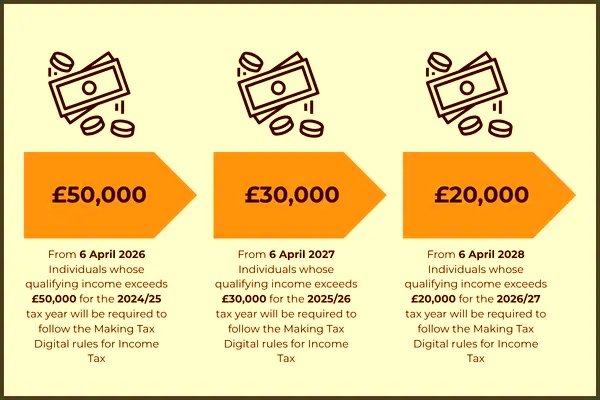
Next, MTD for Income Tax will come into effect for self-employed individuals and property owners earning over £50,000 from April 2026, and for those earning over £30,000 from April 2027. As announced in the 2025 Spring Statement, the threshold will further reduce to £20,000 from April 2028. In time, MTD will also extend to partnerships and limited companies.

So, what does this mean for your business?
Keep reading for a detailed overview of MTD including registration deadlines, compliance requirements, and the software you’ll need to stay on track.

  • ‘HMRC’s ambition is to become one of the world’s most digitally advanced tax administrations in the world.’

What is Making Tax Digital?

Making Tax Digital (MTD) represents a major shift in how individuals and businesses report and pay their taxes. The initiative is designed to make it easier to manage your tax affairs while allowing HMRC to receive information more frequently and accurately.

HMRC’s goal is to create one of the world’s most digitally advanced tax systems. MTD marks a fundamental transformation, making tax administration more effective, efficient, and easier to get right.

The rollout of MTD is gradual. VAT-registered businesses are already required to comply, while self-employed individuals and landlords will soon follow. In time, partnerships and limited companies will also be brought into the scheme.

If your business is VAT-registered, you should already be registered for MTD unless you qualify for an exemption.

For more details, visit our dedicated pages on Making Tax Digital for Income Tax Self-Employed and Making Tax Digital for Income Tax – Landlords.

Shape

The advantages of MTD

Making Tax Digital (MTD) is designed to modernise and simplify tax administration across the UK. It forms a key part of the government’s initiative to help individuals and businesses manage their taxes more accurately and stay on top of their financial affairs.
According to HMRC’s evaluation, around 67% of businesses reported that using MTD-compatible software has reduced the likelihood of errors in at least one area of record-keeping, while 80% found the software easy to use.
MTD offers clear advantages enabling faster, more efficient storage, submission, and access to tax information. However, it also brings certain challenges, including software compatibility, user training, and adapting to new digital reporting requirements, particularly for those working with international partners.

Making Tax Digital Deadlines

Below are the current deadlines to register for MTD if it is applicable to your business. The dates relate to when you need to register. The dates you usually submit tax returns or pay tax bills will not change.
Making Tax Digital for Income Tax (income over £50,000) deadline:
6 April 2026
Making Tax Digital for Income Tax (income over £30,000) deadline:
6 April 2027
Making Tax Digital for Income Tax (income over £20,000) deadline:
6 April 2028
Making Tax Digital for VAT: Now compulsory on registration.

Important:
The first priority is to have a full understanding of the ins and outs of reporting under MTD. If you are required to file your updates using MTD software from April 2026, our recommendation is to sign up to MTD now. By submitting quarterly updates for 2025/26 you will familiarise yourself with the process ahead of April 2026 and ensure there are no last-minute complications.

It’s critical to get advice from qualified accountants who have expert knowledge of this new way of working and at Oakstone Accountants we can guide you through what’s involved with the same refreshingly clear approach that we bring to all our work.

To make sure you’re on the right track and for a complete view of what MTD means for you contact us today.

What Do the Changes Mean?

To comply with MTD, businesses must keep digital financial records using HMRC’s compatible software. You will need to connect this software directly to HMRC in order to file your tax returns.

This connection is known as a “digital link.” HMRC defines a digital link as:

  • Electronic transfer of data between software programs or applications, such as linked spreadsheet cells with formulas.
  • Automated transfer that does not require manual actions like copying and pasting data between software.

In short, HMRC expects your data to be input into one software system and automatically sent to them.

How Do You Register for Making Tax Digital?

MTD for Income Tax is available for testing on the Public BETA before it becomes mandatory in April 2026. You can sign up early through the HMRC website or wait until it becomes compulsory. If your business does not yet have a Government Gateway account, you will need to create one.

You must also use software compatible with MTD. Registering for MTD (VAT) is now automatic for new VAT registrations.

Making Tax Digital Exemptions

Exemptions apply only in specific cases, such as:

  • It is unreasonable for you to use digital tools due to age, disability, or lack of internet access (digital exclusion).
  • Your business is run by members of a religion incompatible with electronic communication.
  • You are the personal representative of someone who has died.

To claim an exemption, you must apply directly to HMRC. Additionally, Trusts, Estates, Trustees of Registered Pension Schemes, and Non-Resident Companies are exempt from MTD.

Software for Making Tax Digital

For a more detailed overview, please see our dedicated page for more information.

We can work with any software; however, if you’re looking for guidance, here is a list of the most recognised software:

  • Xero
  • QuickBooks
  • FreeAgent
  • Sage
  • Hammock for Landlords

You can continue using your existing spreadsheets to manage your records, which will need to be digitally linked to HMRC via bridging software. Bridging software acts as a digital link between your spreadsheet and HMRC, ensuring the data is submitted in the correct format.